Fire safety infrastructure is an essential requirement for industrial facilities, commercial buildings, warehouses, manufacturing units and large infrastructure developments. An effective fire protection arrangement requires a dependable water supply that can support firefighting operations during emergency situations. For facilities where municipal water supply may not provide sufficient pressure or volume, dedicated water storage systems become an important part of fire safety planning.
Fire Rated Water Tanks are used in fire protection infrastructure to maintain the water reserves required by firefighting systems. Their design and installation depend on several technical factors, including building classification, fire risk assessment, required water capacity, pumping arrangements, installation location and applicable fire safety regulations.
Unlike conventional water storage systems, fire protection tanks must be designed to meet specific operational requirements. The stored water must remain available for firefighting purposes, and the tank must be compatible with the connected pumps, hydrants, sprinklers and other fire suppression equipment.
This article explains the types of fire water storage tanks, construction materials, applications, design considerations, installation requirements and maintenance practices relevant to industrial and commercial fire protection systems.
Fire Rated Water Tanks for Fire Protection Systems
Fire Rated Water Tanks are specially designated water storage structures used to maintain the reserve water supply required for firefighting operations. These tanks support fire protection infrastructure such as fire hydrant networks, automatic sprinkler systems, hose reel installations, and other approved firefighting equipment. Their storage capacity is determined according to the water demand, required reserve volume, and specifications of the fire protection system.
The design and construction of these tanks must consider structural strength, water pressure, environmental exposure, corrosion protection, installation conditions, and accessibility for inspection. Appropriate inlet, outlet, overflow, and drainage connections are also necessary to maintain compatibility with the connected firefighting infrastructure. Material selection and tank configuration should follow the applicable fire safety standards, engineering requirements, and project specifications.
Unlike conventional water storage systems, fire protection tanks are planned primarily around emergency water availability. The stored reserve must remain accessible for firefighting purposes and should be maintained through regular inspections, cleaning, and maintenance. Key considerations include dedicated water storage, adequate capacity, suitable construction materials, reliable connections, and convenient maintenance access to support the operational readiness of the fire protection system.
Fire Suppression System Tanks and Their Role in Fire Safety
Fire Suppression System Tanks are designed to store the water required by designated water-based fire suppression arrangements. These tanks are connected to firefighting infrastructure through appropriately engineered pumps, pipelines, and distribution networks. Their primary purpose is to maintain the required water reserve and supply it to the connected equipment when firefighting operations are initiated. The overall arrangement must be planned according to the facility's fire protection design, required flow rate, operating pressure, and water storage duration.
Depending on the application, stored water may be supplied to automatic sprinkler systems, fire hydrant networks, hose reel installations, and external fire hydrants located around industrial or commercial premises. Each connection serves a specific firefighting purpose, making proper coordination between the storage tank, pumping equipment, pipelines, and distribution points important during system design. Tank capacity and outlet arrangements should be established according to the approved fire protection requirements rather than general water consumption.
Standards and Regulatory Requirements for Fire Water Storage Tanks
Fire Water Storage Tanks must be planned and installed in accordance with applicable building regulations, fire safety provisions, and engineering standards. In India, the National Building Code (NBC) 2016 provides important guidelines for fire and life safety in different types of buildings. Depending on the project requirements, relevant Bureau of Indian Standards (BIS) specifications, state and local fire authority guidelines, and approved fire protection system designs may also need to be considered. These requirements help establish suitable storage arrangements for different building occupancies and fire risk categories.
During project planning, several technical and regulatory aspects should be evaluated to determine the appropriate tank specifications. These include the required fire water storage capacity, building occupancy, fire hazard classification, hydrant and sprinkler system requirements, pumping arrangements, water distribution connections, structural stability, and provisions for inspection and maintenance. The tank design should also account for installation conditions, material suitability, and accessibility for routine servicing.
Regulatory requirements may vary according to building type, project location, occupancy, and the firefighting systems installed. Therefore, tank capacity and construction specifications should not be finalized using a single general guideline. Qualified fire protection consultants, structural engineers, and relevant approving authorities should review the project requirements to ensure that the proposed storage system meets applicable safety provisions and approval conditions.
Installation and Maintenance of Fire Service Water Tanks
Proper installation and scheduled maintenance are important for ensuring the structural stability and operational reliability of a Fire Service Water Tank. Installation should begin with foundation preparation based on the total filled tank weight, soil conditions, and site-specific structural requirements. During assembly, manufacturers' approved procedures and connection specifications should be followed carefully. All joints, fasteners, and sealing arrangements must be checked to minimise leakage risks. Inlet, outlet, overflow, drainage, and suction pipelines should be connected according to approved engineering drawings. Before commissioning, the completed installation should undergo structural inspection, alignment checks, and the specified water-filling and leakage tests.
Regular maintenance helps identify deterioration and potential operational issues before they affect the firefighting water supply. Inspections should cover tank surfaces, joints, fasteners, protective coatings, structural components, and pipeline connections. Accumulated sediment should be removed through suitable cleaning procedures, while the available fire water volume, associated pumps, valves, and distribution pipelines should be checked according to the maintenance schedule. Inspection findings and servicing activities should also be documented for future reference. The frequency of inspections and testing should follow applicable regulations, manufacturer recommendations, and the facility's fire safety maintenance plan.
Why Prefabricated Modular Tanks Are Considered for Fire Protection Projects
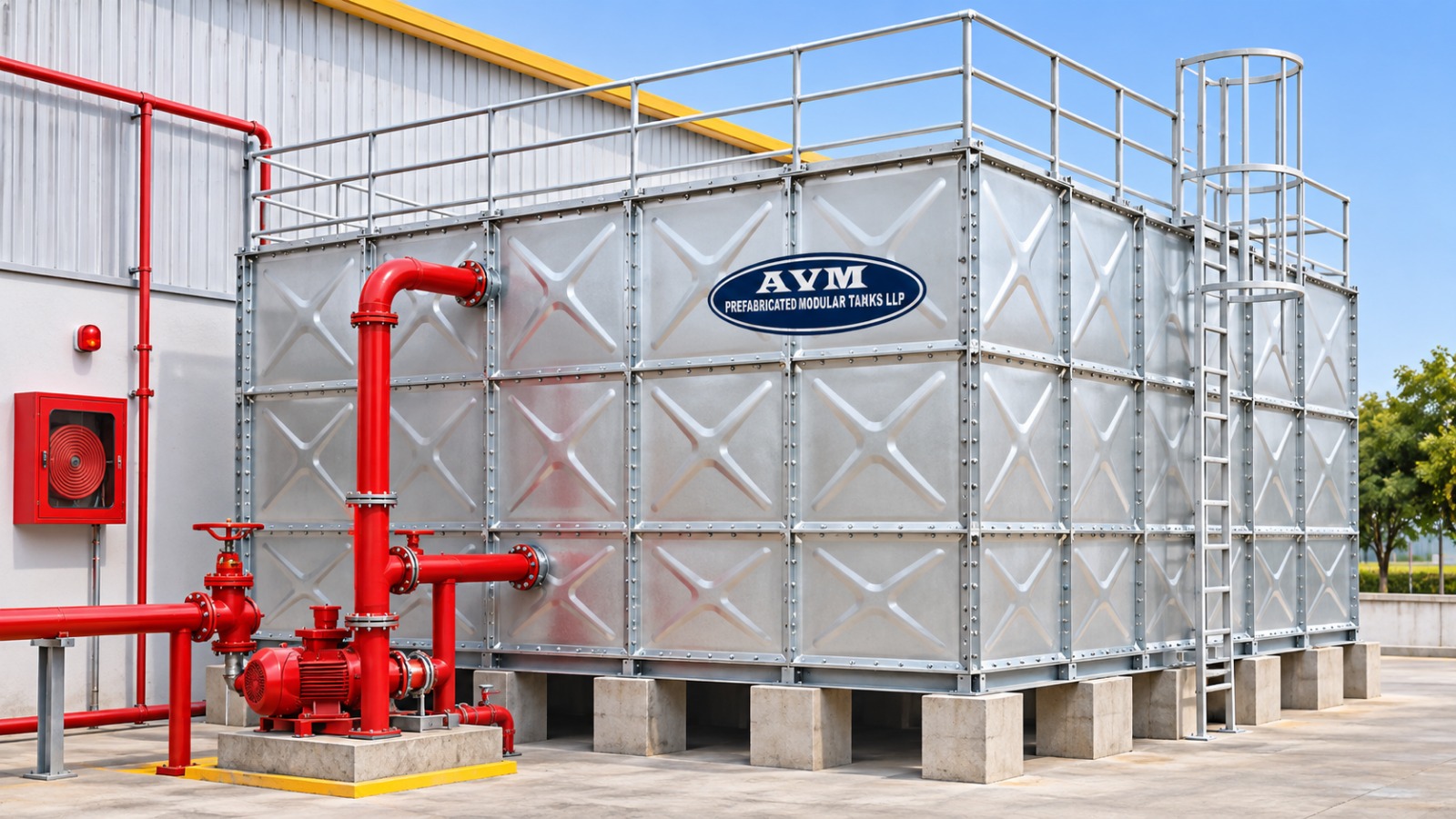
Prefabricated modular tanks are considered for fire protection projects that require engineered sectional water storage systems with application-specific configurations. Unlike conventional tanks that may require transportation as a complete structure, modular systems use individually manufactured panels that can be transported and assembled at the installation site. Their suitability depends on the required storage capacity, site accessibility, structural design, material selection, and approved fire protection specifications.
Several practical considerations make modular tank arrangements relevant to industrial and commercial fire protection projects:
- Sectional Construction: Individual panels can be transported separately and assembled at the project location according to the approved design.
- Site Accessibility: Panel-based transportation can simplify material movement at locations where access for large prefabricated structures is restricted.
- Capacity Configuration: Modular arrangements can be engineered for different storage capacities within the applicable structural design limitations.
- Installation Planning: Factory-manufactured components allow assembly activities to be coordinated with site preparation and project schedules.
- Engineering Coordination: Tank dimensions, foundation requirements, pipeline connections, and additional accessories can be evaluated during the design stage.
For AVM Prefabricated Modular Tanks LLP, modular tank selection should be guided by the intended firefighting application, required storage volume, site conditions, and approved technical specifications. A properly engineered configuration can provide a practical approach to fire water storage while addressing transportation, installation, structural, and operational requirements specific to each project.
Fire Rated Water Tanks are an important component of fire protection infrastructure in industrial facilities, commercial buildings, warehouses and infrastructure developments. Their primary function is to maintain an adequate water reserve for firefighting operations and support the connected hydrant, sprinkler and pumping systems.
The selection of an appropriate storage system depends on several technical factors, including capacity calculations, tank material, structural design, installation conditions, corrosion protection and maintenance accessibility.
Whether a project requires Fire Protection Storage Tanks, Fire Suppression System Tanks or a dedicated Fire Service Water Tank, the configuration should be established through proper engineering calculations and applicable fire safety standards.
Not sure which tank fits your site? Share your application, daily demand and site size — our engineers will size the tank and send a layout with the quote. Talk to an engineer →Factors Affecting the Service Life of Fire Rated Water Tanks
The service life of Fire Rated Water Tanks depends on several factors, including construction quality, material selection, installation practices, stored water characteristics, and maintenance frequency. Each of these elements influences the tank's ability to withstand structural loads, environmental exposure, and continuous water storage conditions. Evaluating these aspects during the design and installation stages helps reduce premature deterioration and maintain the reliability of firefighting water storage infrastructure.
Important factors that influence tank durability and long-term performance include:
- Material Quality: The grade and quality of construction materials influence resistance to corrosion, deformation, and structural deterioration.
- Protective Coating: Appropriate internal and external coatings help protect tank surfaces from moisture, corrosion, and environmental exposure.
- Water Quality: Sediment, dissolved minerals, and impurities can affect internal surfaces and increase cleaning and maintenance requirements.
- Installation Conditions: Proper foundation preparation, panel alignment, joint sealing, and structural support help minimise the risk of leakage and premature damage.
- Environmental Exposure: Temperature fluctuations, humidity, rainfall, and outdoor conditions can affect the performance of tank materials over time.
- Preventive Maintenance: Regular inspections, cleaning, leakage checks, and timely repairs help identify developing problems before they affect tank performance.
A structured inspection and preventive maintenance programme is essential for maintaining the condition of fire water storage systems. Monitoring material deterioration, checking protective coatings, and addressing minor defects at the appropriate time can help extend the useful service life of the tank while supporting the continued availability of firefighting water reserve.
Key Elements That Influence Fire Water Tank Durability
The durability of Fire Rated Water Tanks is influenced by the quality of materials, construction methods, and engineering specifications used during manufacturing and installation. Tank panels, structural supports, fasteners, and connecting components must be suitable for the intended storage capacity and operating conditions. Appropriate protective coatings also play an important role in maintaining surface condition by limiting exposure to moisture, corrosion, and external environmental factors. Selecting suitable construction materials and protection systems during the planning stage helps maintain structural performance over an extended period.
The installation environment is another important consideration when evaluating tank performance. Foundation strength, soil conditions, load distribution, panel alignment, and joint sealing can affect the stability of the complete storage structure. Improper foundation preparation or incorrectly assembled connections may increase the possibility of leakage, uneven loading, and structural deterioration. Water characteristics also require attention because sediment accumulation, dissolved minerals, and impurities can increase internal cleaning requirements. For modular tank installations, following approved assembly procedures and checking fasteners, seals, and connection points are particularly important.
Frequently Asked Questions
A water-based fire protection system uses water to control, suppress, or extinguish a fire. These systems typically include automatic sprinklers, standpipes, fire pumps, hydrants, piping, valves, and a reliable water supply. Because tanks are a critical element in providing safe, secure water, dedicated storage may be necessary when the municipal supply cannot provide the required flow, pressure, or duration.
Common storage options include cst fire protection water storage tanks, nfpa 22 fire protection water storage tanks, and nfpa 22-compliant fire protection water tanks. Depending on site requirements, fiberglass tanks deliver dependable water storage for fire suppression systems, while frp water storage tanks provide the perfect balance of durability, fire resistance, corrosion protection, and low maintenance. In suitable installations, pioneer water tanks are cost-effective for dual purposes, such as combining fire protection reserves with another approved water-storage use.
A water fire suppression system is an automatic fire-protection setup that uses stored water to control or extinguish a fire. A tank fire suppression system combines a water-storage tank with a system that supplies sprinklers; in suitable installations, plastic fire suppression water tanks can be used. The best: choice depends on capacity, code requirements, and site conditions—why: because a reliable water supply is essential for fire protection. Equipment or service providers such as eurofeu may be considered, while pioneer water tanks are engineered to nfpa standards for water storage for fire protection. These tanks support fire protection and fire suppression systems and are used to store water used by the fire sprinkler systems. Because such systems are automatic, they eliminate the need for human activation or intervention.
Water tanks can be made from plastic/polyethylene, steel (including corrugated steel), concrete, fiberglass, or collapsible fabric materials. For fire-protection water storage, common choices include plastic fire suppression water tanks, fire protection water tanks, and cst fire protection water storage tanks. Pioneer water tanks are engineered to nfpa standards for water storage for fire protection, and example: suitable tank materials must be selected for the required capacity, installation, and local code conditions. Note: actual sizing and hydraulic calculations should always be prepared, verified, and stamped by a licensed fire protection engineer (fpe) and formally approved by your local ahj or fire code official. Depending on jurisdiction, compliance with water supply (water fittings) regulations 1999 may also apply. Why it is safe: properly designed tanks support a reliable water supply; portable water tanks provide back-up facilities for fire fighting, and portable water tanks are essential for establishing water supply at fire scenes. A collapsible water storage tank can also be used where flexible deployment is needed. These tanks provide the water necessary for fire suppression purposes inside the building, while ensuring water quality in fire suppression tanks helps maintain reliable fire-protection performance.
Determining the capacity of a fire protection storage tank involves a careful assessment of several key factors, including the building type, occupancy classification, fire flow requirements, applicable building codes, and local fire authority regulations. Engineers and fire safety professionals calculate the required water volume based on the anticipated duration of fire suppression activities, the number of sprinkler heads, and the potential fire hazard level of the facility.
Among the most versatile options in the market, Pioneer water tanks are cost-effective for dual purposes, serving both fire protection and general water storage needs. These tanks provide an economical solution for businesses looking to maximize their investment.